|
|
Effects of Caffeine and Coffee on Irritable Bowel Syndrome, Crohn's Disease, & Colitis
|
The article below is an in-depth review of the current research available about the affects of caffeine and coffee on conditions of the colon, including Crohn's Disease, Colitis, and IBS. It is primarily intended for health care and medical professionals. If you would like to read a summary of the main points in this article, click here.
If you've already decided you need to eliminate, or cut back, on coffee in your diet, click here for a simple, easy to follow program to quit coffee painlessly in just two weeks.
Too much caffeine in your diet? Click here to take our daily caffeine intake quiz.
For more information about Teeccino caffeine-free herbal coffee and its nutritious health benefits, click here.
|
© Teeccino 2004 Reviewed by Meri Rafetto, RD, Theresa Grumet, RD, and Gerri French, RD, MS, CDE Click Here for PDF of Article (52 KB) |
The prevalence today of Irritable Bowel Syndrome (IBS) and inflammatory bowel diseases such as Crohn’s disease and ulcerative colitis among the adult population is linked to causative factors from both stress and diet. Twenty percent of adults are estimated to be suffering from IBS alone with symptoms of abdominal pain, bloating, flatulence and constipation and/or loose stools. Certain foods including: caffeine, coffee, decaffeinated coffee, insoluble fiber, alcohol, chocolate, hot spices, carbonated drinks and foods high in fat can trigger IBS symptoms. 1, 2, 3 Additionally, certain food intolerances may trigger IBS like dairy products and gluten containing grains.
As many as 1.4 million4 people in the United States suffer from inflammatory bowel diseases (IBD); a state of intestinal inflammation so severe that the disease interferes with their nutritional status and their ability to absorb nutrients in the intestinal tract. A common characteristic of those suffering from Crohn’s disease and ulcerative colitis is a compromised ability to properly digest and absorb necessary nutrients, leading to deficiencies. People suffering from IBS, Crohn’s disease and colitis find that making certain dietary changes can be very helpful to relieve symptoms and prevent recurrence.
Of all the dietary habits that people find difficult to change, coffee drinking is one of the most challenging because it is so entrenched in cultural habits and caffeine addiction.5 Withdrawal symptoms can involve painful headaches, nausea, vomiting, and loose stools.6 People whose health problems would be ameliorated if they gave up coffee can improve their chance for successfully quitting coffee if they have both a satisfying alternative and a method to slowly decrease their caffeine intake to reduce withdrawal symptoms.
The following characteristics of coffee have an adverse effect on the intestinal tract:
- Coffee Stimulates the Gastrointestinal (GI) Tract to Overactivity
- Coffee produces a laxative effect in susceptible people through stimulation of rectosigmoid motor activity, as soon as four minutes after drinking. Even modest doses of coffee can have this effect, whether or not the body is ready to dispose of the feces, resulting in loose stools. Studies show that decaffeinated coffee has a similar stimulant effect on the GI tract proving that the laxative effect is not only due to caffeine. 7, 8, 9
- Coffee Elevates Stress Hormones
- Caffeine in coffee elevates the stress hormones cortisol, epinephrine (also known as adrenaline) and norepinephrine.10, 11, 12 These hormones are responsible for increased heart rate, increased blood pressure, and a sense of "emergency alert". Blood is diverted from the digestive system which can cause indigestion. The circulation of oxygen to the brain and extremities is decreased and the immune system is suppressed.
- The purpose of this “fight or flight” response is to provide the body with a temporary energy boost for intense physical activity. With today’s sedentary lifestyle, the continual state of increased stress resulting from caffeine consumption can affect health especially in those types of disorders like IBS and IBD that are sensitive to stress, particularly because neural control of the gastrointestinal tract is affected by stress and emotions.13, 14, 15
- The Acidity of Coffee Irritates the Intestines
- Coffee is highly acidic and it can stimulate the hypersecretion of gastric acids. Decaffeinated coffee has been shown to increase acidity to a greater degree than either regular coffee or caffeine alone.16 Both caffeine and coffee stimulate gastric acid secretion and decaffeinated coffee raises serum gastrin levels.17, 18 A study comparing the effect of decaffeinated coffee on gastric acid secretion and gastrin levels to high protein meals, which normally stimulate high acid production, found that decaffeinated coffee was a more powerful stimulant of acid secretion and gastrin release than the meals.19
- Coffee tends to speed up the process of gastric emptying, which may result in highly acidic stomach contents passing into the small intestine too soon. This may lead to injury of the intestinal tissue.20
- Caffeine Decreases Magnesium Absorption
- Magnesium is one of the most plentiful minerals in the body and plays an essential role in more than 300 cellular reactions. When magnesium is low in the body, it will be pulled from cells to maintain plasma concentration, so magnesium deficiencies are difficult to detect. Adequate magnesium is important for maintaining bowel regularity and magnesium is often used to produce a laxative effect in constipation. For people suffering from irritation of the mucous membranes within the colon present in irritable bowel disease, the presence of adequate dietary magnesium is essential. Magnesium is necessary for stable collagen formation in connective and epithelial tissue.21 It is also a crucial mineral for the biochemical processes involved in wound healing,22 making it vital to healing the irritated lining of the colon in IBS.
- Caffeine Acts as a Diuretic
- The diuretic effect of caffeine causes excretion of fluid through the kidneys, which can lead to dehydration. Since water is an important part of the digestion and elimination process, dehydration due to excess caffeine intake may produce hard stools that are difficult to pass leading to constipation.21
- Caffeine Interferes with GABA Metabolism
- GABA (Gamma-aminobutyric acid) is a neurotransmitter that is naturally produced in the brain and the GI tract. It plays an important role in mood and stress management and it exerts a calming effect on the GI tract.
- Caffeine has been found to interfere with binding of GABA to GABA receptors, preventing it from performing its calming function.22 In cases of IBS, ulcerative colitis, and other lower digestive disorders in which the lower GI tract is already irritated and often hyperactive, the lack of GABA’s effect only further exacerbates the problem. In addition to the direct effect on the GI tract, GABA’s role in stress management is also compromised in the presence of caffeine since psychological stress is known to be a contributing factor in IBS.23, 24
Recommendation:
Based on the unfavorable effects that coffee and caffeine have been shown to have on the GI tract, anyone suffering from gastrointestinal disorders should eliminate coffee drinking and any caffeine intake from other dietary sources. In the case of IBS, Crohn’s disease and ulcerative colitis, the lower GI tract is already irritated and hypersensitive. Dietary changes that include weaning off of coffee and all other sources of caffeine can help relieve symptoms of these disorders.25 Nutritional professionals can support people with bowel disorders who are changing their coffee drinking habits through the processing of substituting a non-caffeinated, soothing, alkaline herbal coffee that brews and tastes just like coffee.
Kicking the Caffeine Habit:
The social prevalence of coffee drinking and the addictive side effects of caffeine can cause problems with patient compliance. Caffeine-free herbal coffee marketed under the brand name of Teeccino® helps coffee drinkers replace their regular or decaf coffee with a satisfying alternative. Coffee drinkers need a dark, full-bodied, robust brew to help satisfy their coffee craving. Teeccino satisfies the 4 needs coffee drinkers require in a coffee alternative:
- Teeccino brews just like coffee, allowing coffee drinkers to keep their same brewing ritual.
- It has a delicious, deep roasted flavor that is very coffee-like.
- It wafts an enticing aroma.
- People experience a natural energy boost from nutritious Teeccino.
Teeccino offers the following health benefits to people suffering from gastrointestinal and lower GI tract disorders:
| Beneficial Features of Teeccino |
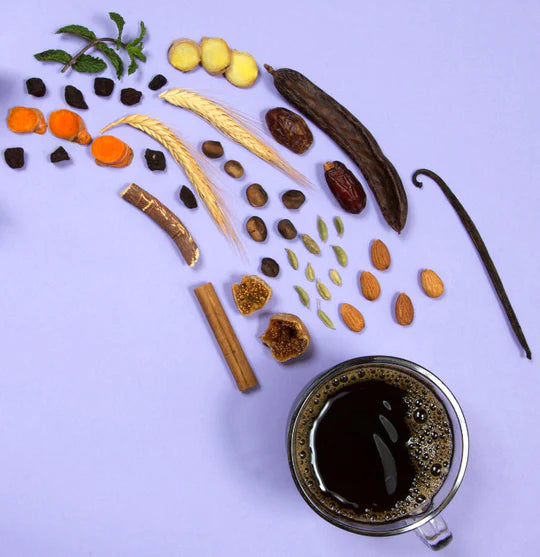
Teeccino Ingredients29, 30, 31, 32 |
- Inulin fiber from chicory
- Unlike coffee, Teeccino has nutritional value, including inulin, a soluble fiber that helps support a healthy population of beneficial microflora.
- Inulin improves mineral absorption,
- Naturally Caffeine-free
- No chemical processing like decaf coffee
- 65 mg of Potassium
- Teeccino is a source of potassium, an electrolyte mineral that is often deficient especially in those suffering from diarrhea disorders.
- Potassium in liquid form is easily absorbed to help relieve muscle, mental and nervous fatigue.
- Alkaline – helps reduce acidity
- As opposed to acidic coffee, Teeccino is alkaline, which is makes digestion more efficient in terms of enzyme function in the small intestine.
- Gluten Free
- Gluten does not extract into boiling water. Tests show Teeccino is gluten free although it contains barley.
|
- Carob
- An herb that has long been used for various diarrhea disorders due to its anti-diarrheal properties.
- Barley
- Has a soothing effect on the GI tract and has been used to treat diarrhea, gastritis and inflammatory bowel conditions.
- Chicory root
- Used to treat abdominal cramps, vomiting, and diarrhea.
- Contains inulin fiber.
- Almond
- The high tannin content of almonds has an anti-diarrheal effect. Also useful for treating other gastric complaints and gastritis.
- Figs
- Mucilages and pectin within the fruit make it useful for treating diarrhea. In China, figs are commonly used for dysentery and enteritis.
- A good source of potassium.
- Dates
- In Indian medicine, traditionally used for relief of gastric complaints.
- Contain some potassium.
|
The Pain-free Way to Wean off of Coffee
Start by mixing normal coffee 3/4 to 1/4 Teeccino Herbal Coffee. Gradually reduce the percentage of coffee over a two to three week period until only 100% Teeccino Herbal Coffee is brewed. Gradual reduction of caffeine is recommended.26 Side effects such as headaches, fatigue, and brain fogginess can be avoided as the body gradually adjusts to less reliance on stimulants.
Example: Use the following proportions if you make a 10-cup pot of coffee daily:
| Day |
Regular Coffee |
Teeccino |
| Day 1-3: |
4 tablespoons |
1 tablespoons |
| Day 4-6: |
3 tablespoons |
2 tablespoons |
| Day 7-9: |
2 tablespoons |
3 tablespoons |
| Day 10: |
1 1/2 tablespoons |
3 1/2 tablespoons |
| Day 11: |
1 tablespoon |
4 tablespoons |
| Day 12-13: |
1/2 tablespoon |
4 1/2 tablespoons |
| Day 14: |
none |
5 tablespoons |
References
- NIH Publication No. 03-4686, copyright 2003.
- Simren, M., Mansson, A., Langkilde, A.M., Svedlund, J., Abrahamsson, H., Bengtsson, U. and E.S. Bjornsson. Food-related gastrointestinal symptoms in the irritable bowel syndrome. Digestion. 2001;63(2):108-15.
- Russel M.G., L.G. Engels, J.W. Muris, C.B. Limonard, A. Volovics, R.J. Brummer, R.W. Stockbrugger. 1998. Modern life in the epidemiology of inflammatory bowel disease: a case-control study with special emphasis on nutritional factors. European Journal of Gastroenterology and Hepatology, Mar;10(3):243-9
- Loftus, E.V. Jr. 2004. Clinical epidemiology of inflammatory bowel disease: Incidence, prevalence, and environmental influences. Gastroenterology, May;126(6):1504-17.
- Braun, S. Buzz: The Science and Lore of Alcohol and Caffeine. Copyright 1996.
- Strain, E.C., G.K. Mumford, K. Silverman, and R.R. Griffiths. 1994. Caffeine dependence syndrome. Journal of the American Medical Association, 272:1043-1048.
- Brown S.R., P.A. Cann, and N.W. Read. 1990. Effect of Coffee on Distal Colon Function. Gut, Apr;31(4):450-3.
- Rao, S.S., Welcher, K., Zimmermn, B. and Stumbo 1998. Is coffee a colonic stimulant? European journal of gastroenterology & hepatology. 10(2):113-8.
- Boekema, P.J., Samsom, M., van Berge Henegouwen, G.P. and A.J. Smout. 1999. Coffee and gastrointestinal function: facts and fiction. A review. Scandinavian journal of gastroenterology. Supplement. 230:35-9.
- Robertson, D., Frolich, J.C., Carr, R.K., Watson, J.T., Hollifield, J.W., Shand, D.G. and J.A. Oates. 1978. Effects of caffeine on plasma renin activity, catecholamines and blood pressure. New England Journal of Medicine. 298(4):181-6.
- Lane, J.D., Adcock, R.A., Williams, R.B. and C.M. Kuhn. 1990. Caffeine effects on cardiovascular and neuroendocrine responses to acute psychosocial stress and their relationship to level of habitual caffeine consumption. Psychosomatic Medicine. 52(3):320-36.
- Lane, J.D. 1994. Neuroendrocine Responses to Caffeine in the Work Environment. Psychosomatic Medicine. 546:267-70.
- Dapoigny, M., R.W. Stockbrugger, F. Azpiroz, S. Collins, G. Coremans, S. Muller-Lissner, A. Oberndorff, F. Pace, A. Smout, M. Vatn, and P. Whorwell. 2003. Role of Alimentation on Irritable Bowel Syndrome. Digestion, 67(4):225-33.
- Simren, M., A. Mansson, A.M. Langkilde, J. Svedlund, H. Abrahamsson, U. Bengtsson, and E.S. Bjornsson. 2001. Food-related gastrointestinal symptoms in the irritable bowel syndrome. Digestion, 63(2):108-15.
- Mulak, A. and B. Bonaz. 2004. Irritable bowel syndrome: a model of the brain-gut interactions. Medical Science Monitor : International Medical Journal of Experimental and Clinical Research 10(4):RA55-62.
- Cohen, S. and Booth, G.H. Jr. 1975. Gastric acid secretion and lower-esophageal-sphincter pressure in response to coffee and caffeine. New England Journal of Medicine. 293(18):897-9.
- Coffey, R.J., Go, V.L., Zinsmeister, A.R. and DiMagno, E.P. 1986. The acute effects of coffee and caffeine on human interdigestive exocrine pancreatic secretion. Pancreas. 1(1):55-61.
- Borger HW, Schafmayer A, Arnold R, Becker HD, Creutzfeldt W. 1976. The influence of coffee and caffeine on gastrin and acid secretion in man. Deutsche medizinische Wochenschrift. 101(12):455-7.
- Feldman EJ, Isenberg JI, Grossman MI. 1981. Gastric acid and gastrin response to decaffeinated coffee and a peptone meal. JAMA. 246(3):248-50.
- H. Glatzel and K. Hackenberg, Effects of Caffeine Containing and Decaffeinated Coffee on the Digestive Functions: X-ray Studies of the Secretion and Peristalsis of Stomach, Intestines and Gallbladder. Medizinische Klinik, April 21, 1967;62(16):625-28.
- Vaxman, F., Olender, S., Lambert, A., Nisand, G. and Grenier, J.F. 1996. Can the wound healing process be improved by vitamin supplementation? Experimental study on humans. European Surgical Research. 28(4): 306-14.
- Utley, R. 1992. Nutritional factors associated with wound healing in the elderly. Ostomy Wound Management, 38(3):22, 24, 26-7.
- R.R. Babb, Coffee, Sugars, and Chronic Diarrhea: Why a Dietary History Is Important. Postgraduate Medicine, June 1984;75(8):82
- Roca, D.J., G.D. Schiller, and D.H. Farb. 1988. Chronic Caffeine or Theophylline Exposure Reduces Gamma-aminobutyric Acid/Benzodiazepine Receptor Site Interactions. Molecular Pharmacology, May;33(5):481-85.
- Lea, R. and Whorwell, P.J. 2004. Psychological influences on the irritable bowel syndrome. Minerva Medica. 95(5):443-50.
- Lea R, Whorwell PJ. 2003. New insights into the psychosocial aspects of irritable bowel syndrome. Current Gastroenterology Reports. 5(4):343-50.
- Cherniske, S. Caffeine Blues: Wake Up to the Hidden Dangers of America’s #1 Drug. Copyright 1998.
- Silverman, K., Evans, S.M., Strain, E.C. and Griffiths, R.R. 1992 Withdrawl Syndrome after the Double-Blind Cessation of Caffeine Consumption. The New England Journal of Medicine. 16(327): 1109-14.
- Fetrow, C.W. and J.R. Avila. Professional’s Handbook of Complementary and Alternative Medicines. Second Edition. Copyright 2001.
- Murray, M., and J. Pizzorno. Encyclopedia of Natural Medicine, Revised Second Edition. Copyright 1998.
- Physicians Desk Reference for Herbal Medicines. Second Edition. Copyright 2000.
- Roehl, E. Whole Foods Facts: The Complete Reference Guide. Copyright 1996.
|
|